The challenge
Energy constraint on construction sites
Our client, a specialist in commercial and residential construction in southern France, relies heavily on tower cranes across multiple simultaneous construction sites.
Each new project presents a recurring energy constraint.
In France, construction sites typically operate under one of two electricity tariffs:
- Blue Tariff: Limited to 36 kVA, quick to connect and more economical
- Yellow Tariff: Higher capacity, significantly more expensive and slower to install
Tower cranes regularly exceed the 36 kVA limit during peak load operations.
When the Yellow Tariff is unavailable, delayed, or considered too costly, contractors commonly rent diesel generators to supplement the Blue Tariff and avoid power outages.
The limits of diesel-based solutions
While effective in preventing interruptions, this approach introduces significant drawbacks:
- Local emissions and noise pollution
- Complex diesel fuel logistics
- Additional operational costs
- Increased mechanical wear and maintenance
The site required a reliable, cost-effective, and low-carbon solution capable of absorbing crane peak loads without upgrading the grid connection or relying on diesel generation.
The Kinell solution
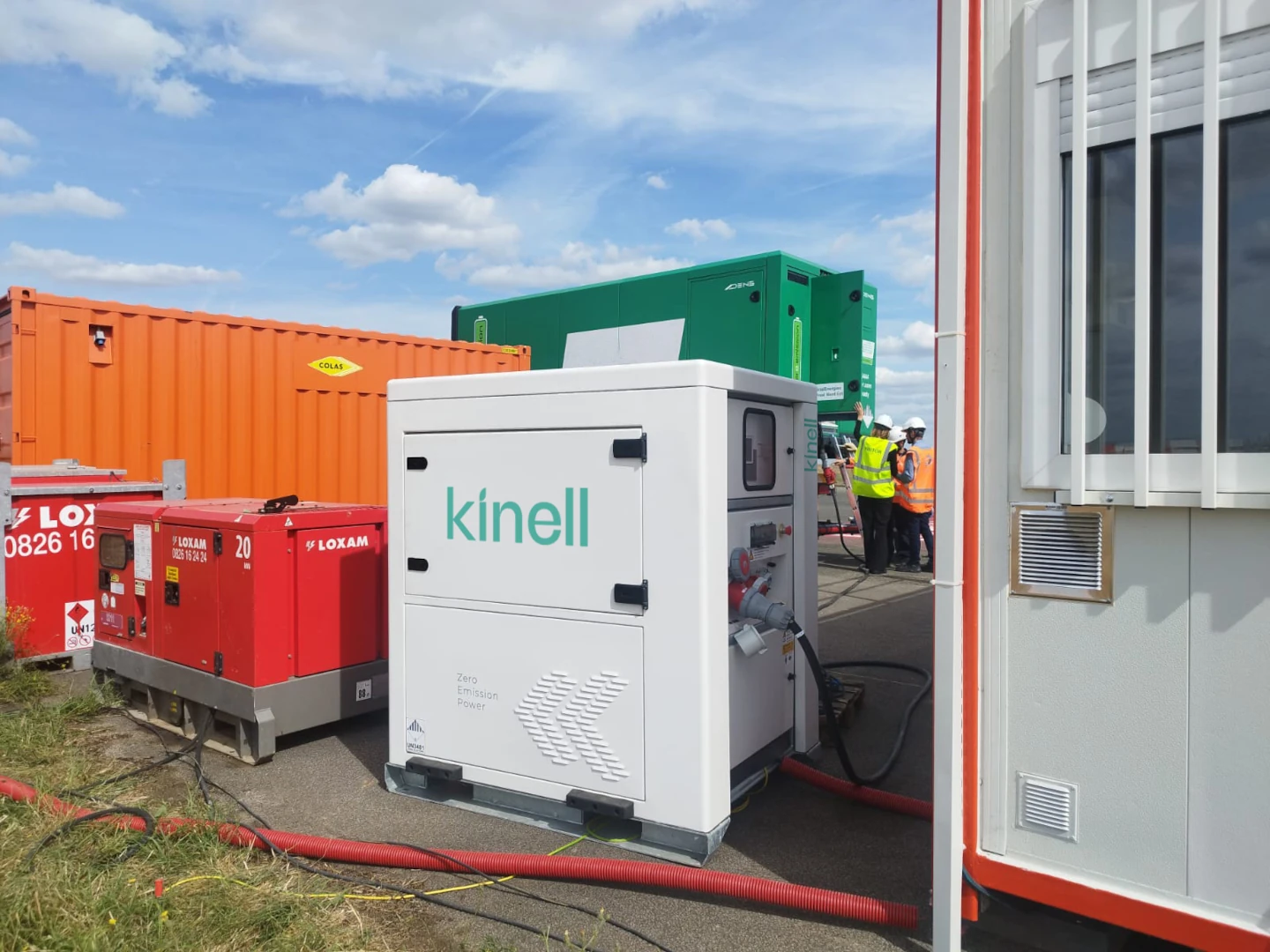
Kinell designed a peak-shaving energy architecture based on its BESS 45/60 (Battery Energy Storage System).
With a 45 kVA power rating and 57 kWh storage capacity, the BESS integrates directly with the Blue Tariff supply.
Instead of upgrading to the Yellow Tariff or supplementing with diesel, the system absorbs peak power demands from the crane. During standard operation, the grid supplies the site and recharges the BESS. When crane demand exceeds the 36-kVA limit, the BESS instantaneously provides additional power.
This configuration maintains stable electricity supply without tariff upgrades or generator rental.
Deployment and daily operation
The BESS was installed alongside the Blue Tariff connection and integrated into the site’s electrical distribution network.
It powers both:
- Site facilities (offices, rest areas, alarms, sanitation units)
- Core operational equipment, including the Potain MDT178 tower crane
The system recharges during low-demand periods and overnight via the standard grid connection.
During crane peak load phases, the BESS automatically compensates for excess demand, preventing power cuts and maintaining full crane responsiveness.
This configuration ensured:
- Stable electricity supply despite peak crane loads
- Elimination of diesel generator use
- No power cuts or work stoppages
- Reduced operational and logistical constraints
Following successful deployment, the client expanded the solution across five simultaneous construction sites, integrating peak shaving as a standardized energy strategy within their operations.
Measured environmental impact
Environmental performance was evaluated against the traditional model of supplementing Blue Tariff power with a diesel generator.
By eliminating generator use, the BESS-based configuration achieved:
- Over 90% reduction in CO₂ emissions
- 100% elimination of local emissions on site
In addition to carbon reduction, the solution eliminates noise pollution and diesel fuel logistics from crane operations.
Key benefits

Peak load management
without tariff upgrade
• Absorbs crane power peaks beyond 36 kVA
• Avoids costly Yellow Tariff connection

Elimination of diesel generators
• Over 90% reduction in CO₂ emissions compared to diesel generator use
• 100% elimination of local emissions on site
• No fuel logistics or on-site refueling

Operational continuity
• No power cuts or crane stoppages
• Improved crane responsiveness

Cost & maintenance optimization
• Reduced operational costs
• Lower equipment wear and servicing requirements
Conclusion
This project demonstrates how peak-shaving energy storage can fundamentally transform crane power management on construction sites.
By combining grid supply with intelligent battery storage, Kinell enables contractors to avoid tariff upgrades, eliminate diesel generators, and significantly reduce emissions without compromising performance.
Beyond supplying equipment, Kinell delivers integrated energy optimization solutions that enhance both economic and environmental performance across multiple construction projects.