The challenge
Our client, a construction company based in the Paris region, was tasked with building new runways at Paris Charles de Gaulle Airport, a large-scale infrastructure project extending over several kilometers.
Multiple teams were deployed simultaneously along the runway, each operating independent temporary facilities, including offices, changing rooms, restrooms, and canteens.
The operational context created several constraints:
- No access to grid connection due to the remote and logistically complex airport environment
- Continuous power demand across multiple temporary site installations
- Strict logistical restrictions related to fuel transport and storage within an airport perimeter
- The need to significantly reduce carbon emissions on a high-visibility infrastructure project
Traditionally, such sites rely on diesel generators operating continuously to ensure uninterrupted power supply.
However, for this high-profile project, the client sought a more sustainable approach, one that would significantly reduce carbon emissions while minimizing fuel logistics, particularly constrained within an airport environment.
The Kinell solution
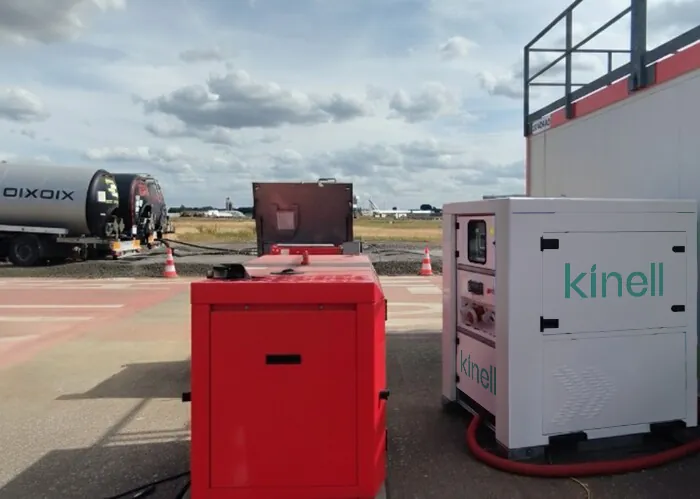
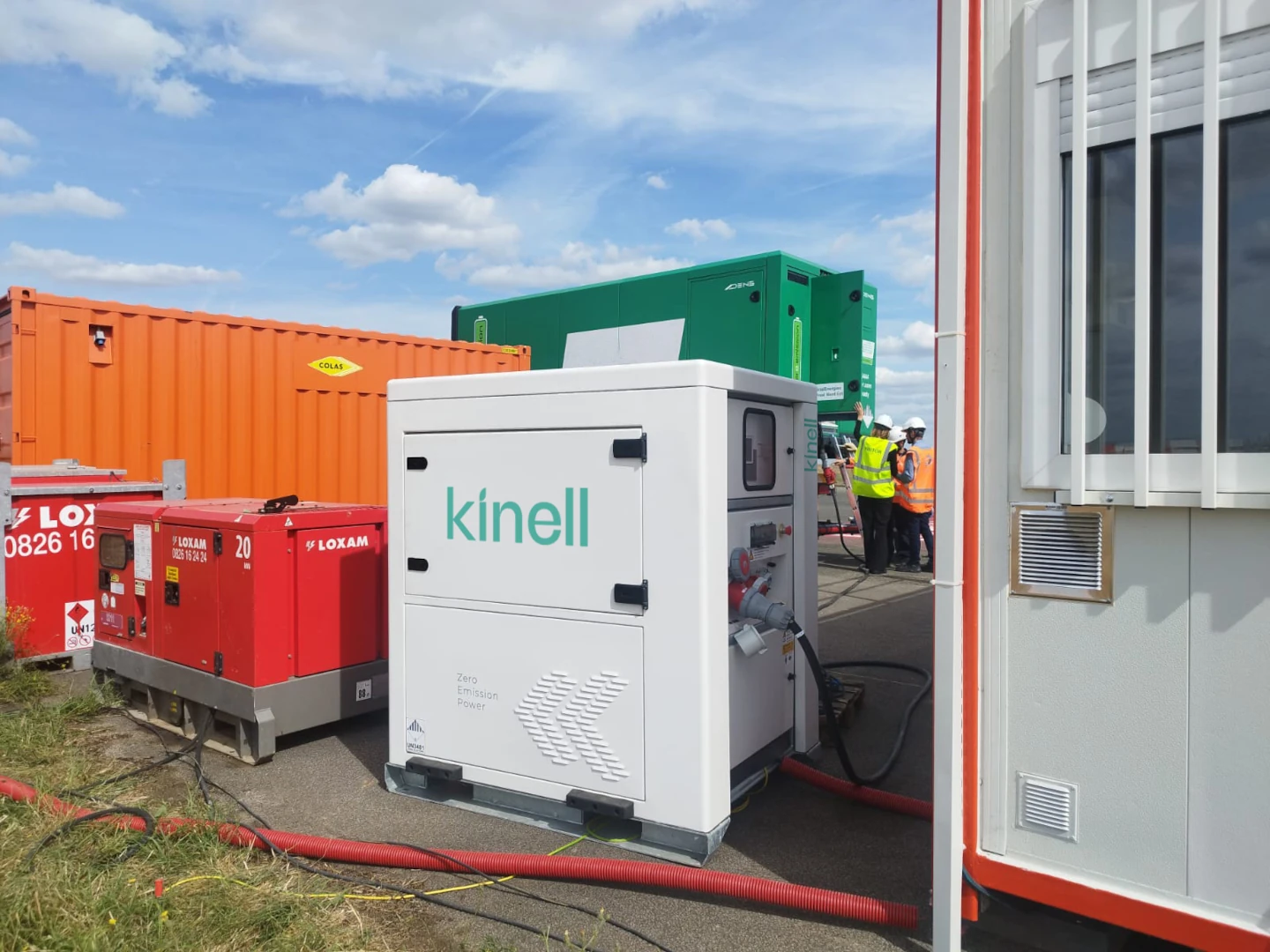
Kinell designed a hybrid energy architecture combining existing diesel generators with multiple BESS 45/60 (Battery Energy Storage Systems).
Rather than replacing diesel generation, the solution redefined its role. Generators were configured to operate only when required, supplying the load while charging the BESS. Once charged, the batteries assumed power delivery, allowing the generators to shut down.
This hybrid configuration reduced fuel dependency, minimized runtime, and significantly improved overall energy efficiency while maintaining uninterrupted power supply for all site facilities.
Deployment and daily operation
The hybrid operating cycle is straightforward and fully automated:
- The generator supplies power to the site while simultaneously charging the BESS.
- Once the batteries are fully charged, the generator shuts down.
- The BESS then provides silent power to the facilities.
When battery levels reach a predefined threshold, the system automatically restarts the generator (1).
On this project, measured performance data demonstrated substantial optimization:
- Diesel generators operated for just 35 minutes per day, compared to typical continuous 24/7 operation.
- The BESS units powered site facilities autonomously for the remaining 23 hours and 25 minutes.
The result was a significant reduction in fuel use, emissions, noise, and mechanical wear.
Measured environmental impact
Environmental performance was evaluated against the traditional model of diesel generators operating continuously.
By reducing generator runtime from 24 hours to just 35 minutes per day, the hybrid system achieved a 90% reduction in on-site CO₂ emissions.
This reduction supports the client’s sustainability objectives and highlights how hybrid energy systems can improve operational efficiency.
Key benefits

Reduced
fuel consumption
• Generator runtime reduced to 35 minutes per day
• Significant decrease in diesel usage

90% CO₂
reduction
• Major reduction in on-site carbon emissions

Lower maintenance & extended equipment lifetime
• Reduced engine wear due to minimized runtime
• Lower servicing requirements
Conclusion
This project illustrates a broader reality of the energy transition: electrification is progressing rapidly, while site infrastructure does not always evolve at the same pace.
By designing a practical, mobile energy architecture aligned with real-world constraints, Kinell enabled zero-emission construction while maintaining full productivity.
Beyond supplying equipment, Kinell delivers integrated energy systems that bridge infrastructure gaps and make sustainable operations operationally viable today.