The challenge
Our client, a specialist in underground and industrial networks operating in the Île-de-France region was commissioned to carry out water network works on a construction site located in a designated Zero-Emission zone in a residential area of Paris.
To comply with local environmental regulations, the contractor deployed a Mecalac E12 electric excavator.
However, a critical constraint quickly emerged:
- No access to the electrical grid on site
- No possibility of using a diesel generator due to Zero-Emission requirements
Without a reliable charging solution, daily operations were at risk. The only alternative would have been to transport the excavator back to the company’s facility each evening for recharging adding logistical complexity, time loss, and additional logistics, time loss, and unnecessary emissions.
The site required a reliable, compliant, and operationally simple solution.
The Kinell solution
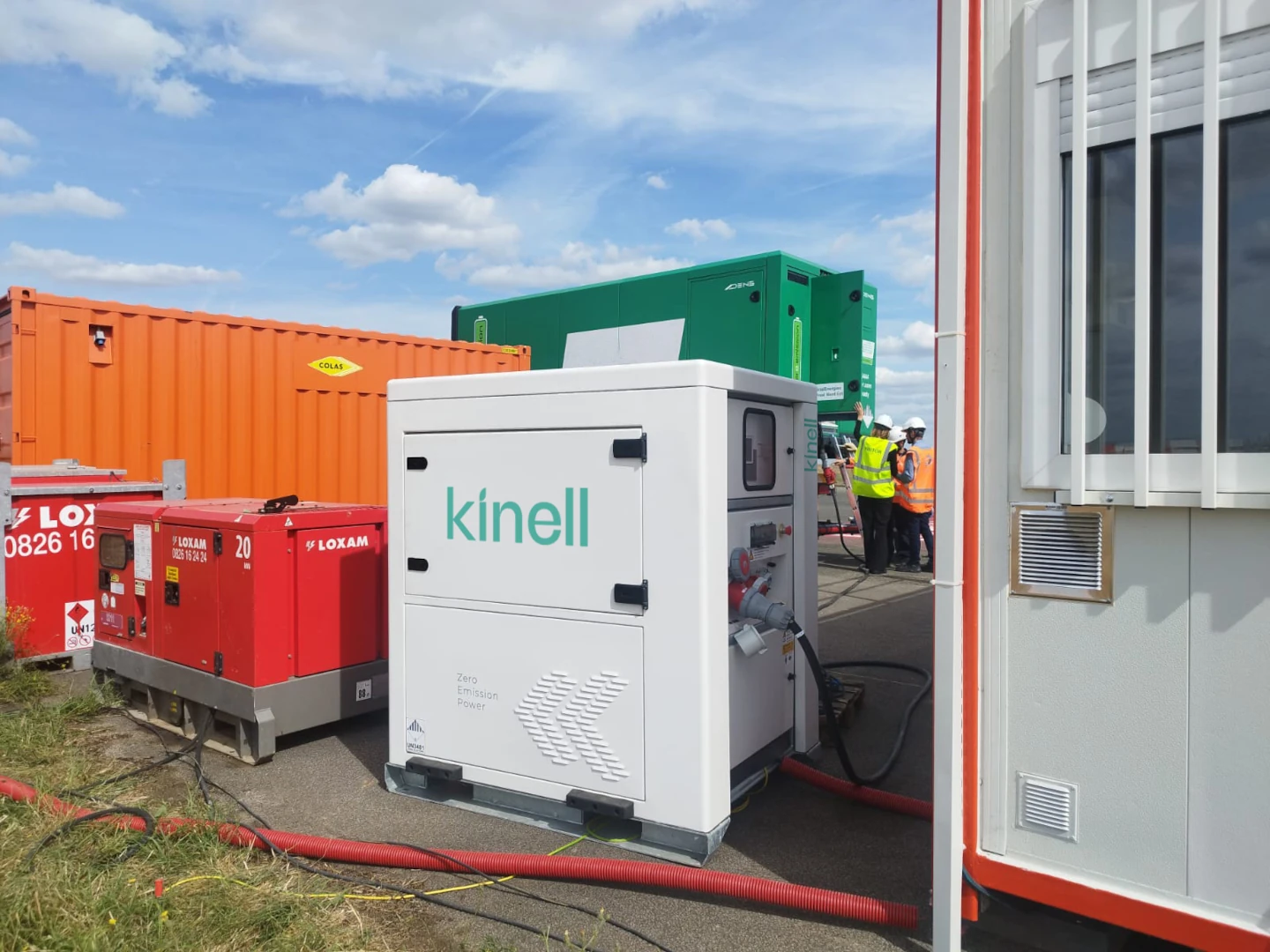
Kinell designed a mobile energy architecture based on its BESS 45/60 (Battery Energy Storage System).
With a 45 kVA power rating and 57 kWh storage capacity, the system was sized to meet the excavator’s daily charging requirements while ensuring safe, efficient overnight operation.
Instead of modifying site infrastructure or introducing complex temporary installations, the solution relied on mobility, repeatability, and seamless integration into existing workflows.
Deployment and daily operation
The client’s main constraint was the absence of any on-site charging infrastructure. The excavator had to be recharged daily to maintain operations, yet the construction site had no grid connection and the use of a diesel generator was prohibited under Zero-Emission regulations.
This created a practical challenge: how to ensure continuous operation without compromising environmental compliance or adding logistical complexity.
In response, Kinell implemented a mobile energy storage solution with its BESS 45/60.
Each evening, a fully charged energy storage system was delivered to the site in a van. At the end of the workday, the excavator was connected and recharged overnight. The silent operation of the BESS ensured that charging could take place without disturbing the surrounding residential area.
By morning, the electric was fully charged and ready for a full day of work. The BESS was then returned to the warehouse, recharged from the grid, and prepared for the next cycle.
This closed-loop system ensured:
- Full compliance with Zero-Emission regulations
- No operational downtime
- No additional site infrastructure
- No logistical disruption
Measured environmental impact
The environmental comparison was established by considering the full operating context, including daily van transport of the BESS, electricity production for recharging, and the manufacturing footprint of the storage system.
Under these conditions, a conventional diesel excavator generates approximately 200 kgCO₂e per working day, primarily from fuel consumption. In comparison, the electric excavator powered using Kinell’s BESS emits approximately 25 kgCO₂e per day, including electricity use, battery transport, and manufacturing impact.
This represents an overall 87.5% reduction in carbon emissions for equivalent operational output.
These results demonstrate that mobile energy storage can significantly reduce site emissions, even when indirect impacts and logistical requirements are fully considered.
Key benefits

Significant
carbon reduction
• 87.5% reduction in CO₂ emissions compared to diesel operation.
• Full compliance with Zero-Emission site requirements.

Reduced
noise impact
• Silent overnight charging.
• Minimal disturbance in a residential environment.

Operational
continuity & simplicity
• Plug-and-play integration with electric machinery.
• No fixed infrastructure required.
• Seamless incorporation into daily site operations.
Conclusion
This project illustrates a broader reality of the energy transition: electrification is progressing rapidly, while site infrastructure does not always evolve at the same pace.
By designing a practical, mobile energy architecture aligned with real-world constraints, Kinell enabled zero-emission construction while maintaining full productivity.
Beyond supplying equipment, Kinell delivers integrated energy systems that bridge infrastructure gaps and make sustainable operations operationally viable today.